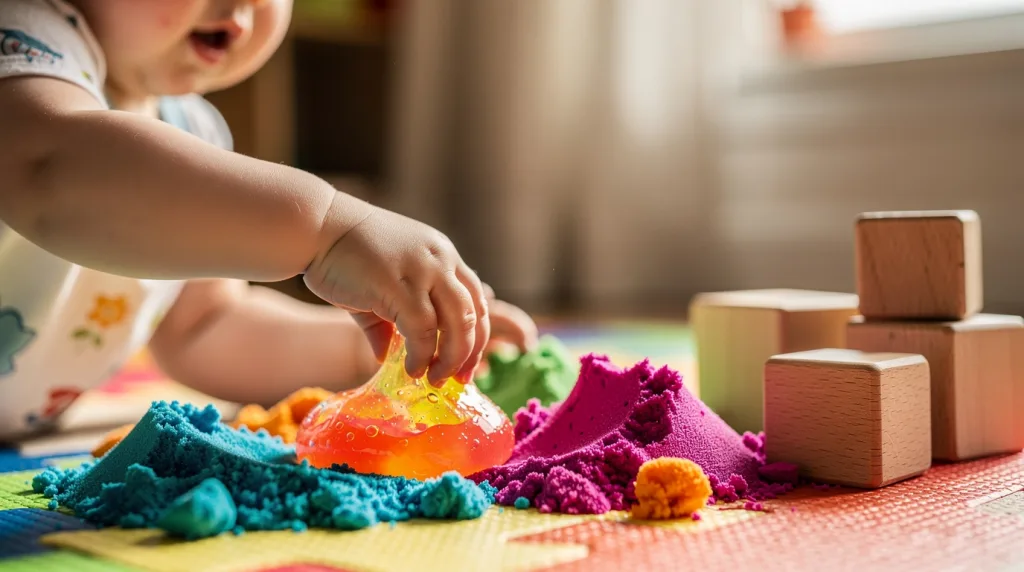
You can boost your child’s language development through sensory play. When they squish playdough or pour water, they’re building vital brain connections. You help them link words like “smooth” or “grainy” directly to the sensation. This hands-on exploration makes new vocabulary stick. Research shows this multi-sensory approach significantly improves word retention. You’ll find specific, age-appropriate activities to try next.
Key Takeaways
- Sensory play engages multiple senses, building neural pathways that directly link sensations to words and boost language acquisition.
- Multisensory stimulation triggers neurotransmitter release, strengthening synaptic connections for faster vocabulary learning and improved retention.
- Hands-on activities like playdough or sand play encourage children to progress from single words to descriptive phrases.
- Research shows structured sensory play can lead to significant vocabulary growth and improved language retention in children.
- Activities can be adapted for different ages and developmental needs, supporting foundational communication skills from infancy onward.
What Is Sensory Play and Why Does It Matter for Language?
Sensory play taps into a child’s natural curiosity by engaging their touch, sight, sound, smell, and taste through hands-on exploration. You see, this isn’t just messy fun; it’s a fundamental framework for development. By directly interacting with materials like water or sand, you help your child’s brain build crucial neural pathways. These pathways directly connect sensory processing regions to language centers in the brain. This simultaneous input of sensory experience and language forms direct brain links between what a child feels and the words they learn.
This process is vital for interpreting sensory input, which is a precursor to understanding and using language. It optimizes their sensory system, creating the foundation for communication, focus, and later academic skills. For children with sensory differences, this play is especially key, offering a tailored way to regulate and engage, setting the stage for language to thrive.
How Sensory Play Builds Vocabulary and Descriptive Language
Those neural connections you’re building through sensory exploration directly fuel your child’s vocabulary. This multisensory engagement activates multiple brain areas, strengthening neural pathways for language. You’ll see this as they grasp words like “splash” from water or “smooth” from clay, linking sensations to language. This hands-on association leads to a richer lexicon than passive learning alone.
Your child naturally progresses from single words to descriptive phrases—”cold and wet”—as sensory play encourages them to articulate complex observations. You’re fostering this growth by providing varied textures and materials, which strengthens their ability to describe the world clearly. These activities don’t just teach words; they build the foundational skills for expressive, confident communication.
The Brain Science: How Multi-Sensory Play Rewires for Language
Multi-sensory play supercharges your child’s brain development by forging robust neural pathways. When you provide rich sensory experiences, you trigger neurotransmitter release that builds synapses for learning. Touching slime while hearing its name directly links tactile and auditory processing centers, creating a fast track for vocabulary. This multi-region activation integrates language with memory and problem-solving.
You enhance brain plasticity, as sensory input stimulates neuron growth and rewires architecture for communication. This process is driven by neurotransmitter release that facilitates the formation of synaptic connections. This process is crucial during early childhood, when plasticity peaks. By combining sensory regulation with language goals, you boost attention and build the foundational networks for later literacy and expressive speech. The science is clear: engaging multiple senses creates a flexible, powerful brain ready for language.
Practical Sensory Activities to Boost Words and Communication
Now that you understand the brain science, let’s translate theory into practice with hands-on activities. You can easily integrate sensory play into daily routines to spark communication. Use playdough to explore words like *soft* and *stretchy*, or let finger painting introduce *sticky* and *smooth*. Sand and water beads offer perfect chances to model terms such as *grainy* and *squishy*.
Boost auditory skills by shaking instruments and labeling sounds as *loud* or *high*. Visually, bright toys and sorting games build color and shape vocabulary. Don’t forget scents and tastes; cooking together teaches *spicy* and *sour*. Combine everything in sensory bins or outdoor exploration. This multisensory approach actively wires your child’s brain for richer, more descriptive language, as varied sensory inputs build neural pathways essential for cognitive growth.
Using Sensory Play for Children With Language Delays
Children with language delays benefit enormously from sensory play—but their needs often require a more intentional approach. You can use a multisensory framework that blends sensory integration with speech-language techniques. This creates an inclusive pathway, building regulation and comfort first to avoid overload. This focused engagement fosters meaningful participation, directly supporting expressive and receptive language growth. Effective therapy often begins with foundational sensory regulation to prepare the child for learning.
Structure play to target specific outcomes. You’ll see increased tolerance to sensory input, improved joint attention, and emerging attempts at requests. Sensory-rich activities build essential descriptive vocabulary like “rough” or “squishy,” enhancing recall and comprehension. By co-targeting sensory and language skills, you address core delays and unlock new developmental advantages.
Connecting Sensory Processing to Speech Development
While sensory play supports all children, its connection to speech development is particularly direct and measurable. For example, a study found that fine motor/perceptual scores on a sensory profile negatively correlated with language conceptual inference ability in children with ASD. Integrated sensory therapy, for instance, dramatically improved speech ability in young children with functional delays. You see this link because sensory processing differences directly correlate with language challenges in conditions like ASD and Developmental Language Disorder.
Specifically, deficits in sensory motor processing can hinder language comprehension and concept formation. Furthermore, children with sensory processing differences often struggle with multisensory integration, making it harder to perceive speech clearly in noisy environments. By engaging tactile, auditory, and motor pathways, sensory play directly stimulates the neural systems that underpin clear speech and robust language skills.
Case Studies: Sensory Play in Action for Communication
From therapy rooms to early learning centers, real-world case studies reveal how sensory play translates into measurable communication gains. You see this in Sathwik’s ASD therapy, where a multisensory framework prioritized comfort and regulation before targeting language. He progressed from tolerating touch and sound activities to maintaining eye contact during stories and answering “what” and “where” questions accurately. At SELC Early Learning Center, researchers tracked 100 children aged 3-5 over six months, documenting a 25% vocabulary increase through descriptive sensory play, 30% more cooperative play, and 20% problem-solving improvement via tactile exploration. You can integrate tactile play to introduce words for textures, auditory activities to build listening and sound discrimination, and visual play to reinforce color and shape concepts. By modeling descriptive words, recasting utterances, and embedding receptive prompts in sensory play, you watch children move from single words to sentences and develop their own questioning skills—exactly what these case studies confirm. These outcomes align with documented 25% vocabulary increases in structured sensory play environments.
What the Research Says: Statistics on Language Growth
Scientific validation now quantifies the anecdotal successes, with research demonstrating that sensory play directly fuels measurable language growth. You’ll find children develop larger vocabularies and more complex sentences, with a 2024 study showing 34% better retention with multisensory methods. When you connect words like “squishy” or “cool” to actual sensations, you accelerate descriptive language acquisition. Further research underscores this link, revealing that children with developmental language disorder exhibit significant sensory processing differences compared to their peers. This happens because sensory play simultaneously stimulates key brain regions like Broca’s area, strengthening neural networks for language. The experience also triggers dopamine, making learning inherently rewarding and motivating repeated exploration. This powerful combination builds a foundation for all complex future skills, giving your child’s development a significant, freedom-filled advantage.
How to Adapt Sensory Play for Different Ages and Needs
Because every child develops uniquely, adapting sensory play requires aligning activities with specific age groups and individual needs.
For infants, you’ll use gentle textures and sounds to build foundational sensory processing and bonding. With toddlers, introduce simple action words during water or Play-Doh play to fuel emerging vocabulary. Preschoolers benefit from multi-sensory bins that encourage descriptive language and peer interaction, as early childhood brain flexibility creates a critical window for building these foundational skills.
For children with language delays, you can target specific sensory quadrants while introducing descriptive words through materials like sand. If a child has ASD or sensory processing issues, prioritize structured, comfortable multisensory therapy that integrates speech techniques to support functional communication and reduce overload. You always tailor the approach to their unique sensory profile and developmental stage.
Conclusion
You’re unlocking your child’s communication potential with every sensory bin and textured play session. Research shows children can use up to 40% more descriptive language after regular multi-sensory activities. So, don’t just play—immerse, describe, and explore together. You’re not just making a mess; you’re building the foundational pathways for clear, confident communication, one scoop of rice and one new word at a time.