
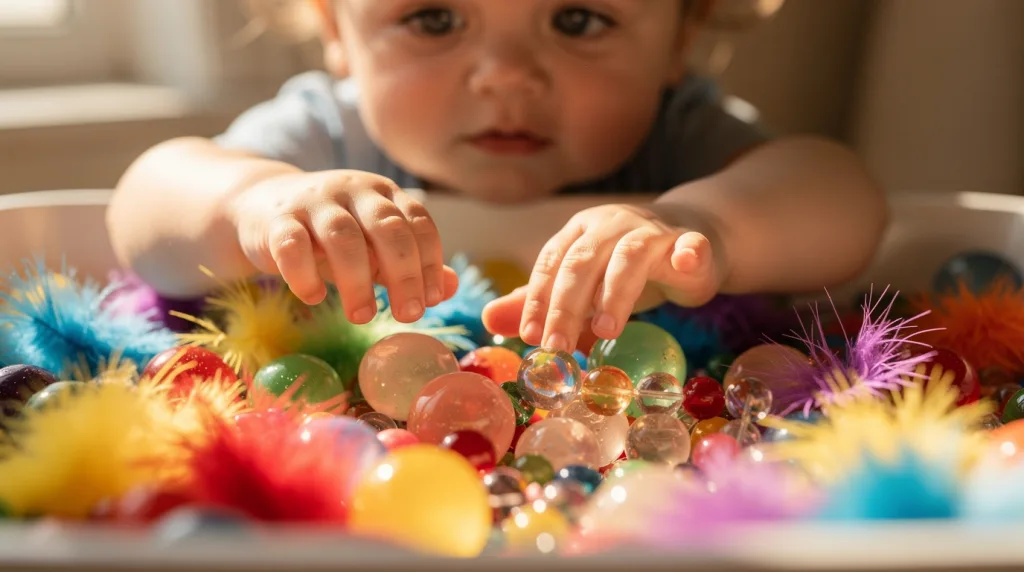
Start sensory play with simple, everyday activities that engage your toddler’s senses. Use a shallow bin with dry rice or cooked pasta for scooping and pouring. Add cups, spoons, or hidden toys to encourage exploration. Always choose non-toxic, age-appropriate materials and supervise closely. These playful moments build crucial neural pathways for brain development, motor skills, and self-regulation. As you explore together, you’ll discover countless ways to adapt and expand the fun.
Key Takeaways
- Start with simple, taste-safe activities like cereal safari or tapioca pearls to engage multiple senses safely.
- Create a dedicated sensory bin with materials like rice or water for scooping, pouring, and sorting.
- Observe your child’s preferences and gradually introduce new textures to build tolerance without overwhelm.
- Ensure a safe environment with non-toxic, age-appropriate materials and soft surfaces for exploration.
- Incorporate movement and music, like action songs or marching, to enhance motor skills and engagement.
What Is Sensory Play and Why It Matters for Toddlers?
Sensory play encompasses any activity that engages a toddler’s senses — touch, sight, sound, taste, smell, and movement. You provide hands-on, exploratory experiences that build crucial neural pathways, supporting brain development and executive function. Through child-led discovery, your toddler develops fine and gross motor skills, connects actions to language, and learns self-regulation. Movement-based sensory activities particularly enhance sensory-motor integration, linking physical actions directly to brain development.
This open-ended play fosters independent problem-solving and creativity, laying a foundation for lifelong learning and adaptability. It’s essential for their rapid growth, helping integrate sensory information for complete understanding. By encouraging these immersive experiences, you support their natural curiosity and holistic development in a way that respects their freedom to explore.
Start Simple: 5 Everyday Sensory Play Activities
Before you think elaborate setups are necessary, remember that effective sensory play often starts with simple, everyday items you already have at home.
Try a Cereal Safari first. Scatter different textured cereals for exploration, or grind them into taste-safe “sand” for digging. Introduce one cereal at a time for younger toddlers—this also helps picky eaters ease into new textures. Tapioca pearls make fantastic edible water beads; boil them, add food coloring, and pair with scoops. Bubble foam engages multiple senses while giving your toddler a messy, thrilling experience. A simple safety reminder is to stick to edible and taste-safe materials for young children. Fill a texture hunt basket with sponges, fabric scraps, pinecones, and smooth stones to build tactile awareness and vocabulary. Finally, add food coloring, flowers, or toys to water for endless pouring and squeezing that strengthens fine motor skills.
Create a Safe Sensory Play Space at Home
In your home, prioritize safety by establishing the play space with soft surfaces, secure mountings, and low-height structures to prevent injuries. Use crash mats and pillows to cushion falls. Design zones with wheeled bookcases for flexibility; include a movement area with low climbing walls and a cozy corner with tents and books for calm. This cozy corner is essential for unwinding and supporting emotional regulation. Incorporate calming elements like soft fairy lights, beanbag chairs, and bubble lamps. Keep walls low-contrast to avoid overstimulation. Add sensory features such as textured mats, high-contrast art, mirrors, and tactile tools like soft brushes. Provide headphones or quiet zones for breaks. Observe your child’s preferences—add cocoon swings or tunnels for seekers, and use visual schedules for predictability. Tailor the space to support your child’s self-regulation and freedom in daily play.
Explore Textures With Sensory Bins and Boards
With your safe sensory space ready, you can fill it with sensory bins—containers packed with materials like dried rice, beans, sand, water beads, or fabric scraps that invite your toddler to scoop, pour, sort, and dig.
These bins strengthen fine motor skills as your child grips spoons, tongs, or tweezers, building hand muscles for future tasks like writing and buttoning. Sorting by color or shape sharpens cognitive development, while narrating actions like “scoop” or “pour” expands vocabulary and cause-and-effect understanding.
You’ll notice textures—rough, smooth, squishy—stimulating multiple senses simultaneously, promoting sensory integration. Hidden objects encourage counting and problem-solving, keeping play purposeful.
Repetitive motions offer calming benefits during transitions, helping regulate emotions. This controlled, engaging stimulation provides a low-stress environment that supports neurotypical and special needs toddlers alike. Let your toddler explore freely; this builds independence and meets their unique sensory needs naturally.
Incorporate Water and Sand for Pouring Fun
Pouring sand and water between containers quickly becomes one of your toddler’s favorite activities, and for good reason—it strengthens fine motor skills, hand-eye coordination, and early math understanding all at once.
You’ll see their grip and precision improve as they practice pouring dry sand, then experience the different weight and flow of water. This open-ended play lets them explore volume and cause-and-effect simply by filling a pail or watching water trickle through a sieve. This also encourages problem-solving as they experiment with sand moisture for building tunnels and structures. Set up a small basin of water or a tray of sand outdoors, provide a variety of cups and funnels, and let them lead the exploration. They’ll build foundational skills for science and math while engaging their senses and calming their minds through repetitive, soothing motions.
Get Creative With Sensory Play Materials Like Playdough
Grab some playdough and watch your toddler’s imagination take flight as they squeeze, roll, and shape it. This simple material builds crucial fine motor strength while giving your child complete creative freedom. It also naturally fosters shared play, which strengthens your bond and models social engagement.
Here’s what playdough offers your little one:
- Hand strengthening: Squishing and rolling builds small muscles needed for scissors, pencils, and buttons
- Sensory exploration: Your toddler discovers textures, pressure, and resistance through hands-on manipulation
- Emotional calm: The repetitive kneading motion soothes anxiety and channels excess energy into focused activity
- Language growth: You’ll naturally introduce words like “squishy,” “flat,” and “round” during play
- Open-ended creativity: There’s no wrong way to play—your child shapes whatever they imagine, building independence and self-esteem
You don’t need fancy tools either. Let them poke, flatten, and tear freely. Their hands and curiosity do the real work.
Add Music and Movement for Auditory Play
Often, your toddler’s day naturally pulses with sound and motion. You can harness this by integrating music and movement into play. Sing action songs like “If You’re Happy and Know It” to connect words with claps or stomps, boosting language and motor skills. Let them tap rhythms with wooden spoons or shake homemade maracas—this builds fine motor coordination and pattern recognition. Marching to a beat or dancing freely develops gross motor skills and sustained attention. These rhythmic activities aren’t just fun; they forge vital brain connections for memory and spatial awareness. This spatial understanding lays groundwork for early mathematical concepts. By encouraging this joyful auditory play, you’re supporting their cognitive growth and sensory-motor integration in a way that feels like pure freedom.
Adapt Sensory Activities for Different Child Needs
While sensory play with music and movement lays a joyful foundation, you’ll soon notice each toddler experiences the world in their own unique way. You can tailor activities to meet their individual sensory profiles, ensuring every child engages comfortably and confidently.
- Hypersensitive children benefit from gradual exposure—start with dry textures, use gloves for painting, and provide quiet retreat spaces with noise-canceling headphones.
- Hyposensitive children thrive with added stimulation through scented playdough, direct finger painting, and hidden objects encouraging deeper exploration.
- Motor skill needs are supported by pouring, scooping, two-handed play, and vertical painting that builds strength and coordination.
- Social interaction needs grow through shared sensory bins, turn-taking games like Sound & Share, and Sensory Storytime with passing props.
- Safety and developmental needs require non-toxic, appropriately sized materials and gradual texture tolerance building matched to your child’s abilities. This thoughtful adaptation also supports healthy emotional regulation.
Progress Play: Layering Skills for Deeper Learning
As your toddler’s brain makes sense of a new texture, sound, or scent, it’s building the very neural pathways that will later support reading, problem-solving, and classroom focus—and you can deepen that growth by layering sensory experiences from simple exploration to more complex, multi-sensory engagement.
Start with a single material, like dry rice for scooping. Then, layer in a scent, like vanilla, or add a tool, like a spoon, to refine motor skills. Progress to combining tasks: transferring scented rice between containers while listening to music. This multi-sensory input strengthens executive functions and attention.
You’ll see their problem-solving and coordination flourish as you build complexity. Such layered, hands-on play proves more captivating than any singular activity, holding their focus longer and solidifying crucial neural connections for future learning. Research indicates that sensory board games effectively stimulate sensory skills development and enhance active interaction among toddlers.
Find Inspiration With Seasonal Sensory Play Ideas
Draw on the natural world around you to spark easy, engaging sensory play that evolves with each season. This approach keeps activities fresh, leverages natural curiosity, and supports crucial neural connections for development. This foundational play is especially powerful as a toddler’s brain is forming over a million neural connections every second.
- Winter: Create a hot cocoa bin with miniature marshmallows for scooping and serving.
- Spring: Set up a water table with cups and funnels for endless pouring exploration.
- Summer: Use kinetic sand for molding and shaping in warm-weather setups.
- Fall: Fill a sensory table with assorted leaves and pinecones for tactile sorting.
- Year-Round: Facilitate taste comparisons, like sampling different apple varieties, to engage multiple senses.
You’ll harness natural curiosity and boost engagement, making learning dynamic and deeply connected to the world.
Engage the Senses: A Quick Guide to Sensory Toys
Building on those seasonal explorations, you can harness everyday sensory toys to turn playtime into powerful learning. These tools boost early brain development and creativity by engaging multiple senses. You strengthen fine motor skills with tactile toys like textured balls or kinetic sand, while auditory instruments like simple drums promote verbal skills and cooperation.
To support self-regulation, offer sensory bottles for visual calm or fidget toys to redirect energy. This reduces challenging behaviors and improves focus. Ultimately, these toys build crucial neuron connections, enhancing memory, problem-solving, and independence for your child’s growing mind.
Conclusion
You’ve got all the tools to spark your toddler’s curiosity. Start with simple activities, create a safe space, and always follow their lead. By weaving sensory play into your routine, you’re not just keeping them busy—you’re building a world of wonder that nurtures their growth. Trust the process, embrace the mess, and watch their confidence bloom through touch, sound, and play.


https://shorturl.fm/Af8Fk
https://shorturl.fm/8Uqu9
https://shorturl.fm/Sd1sW